Telemedicine and Home Care – Connecting Doctors & Patients at Home
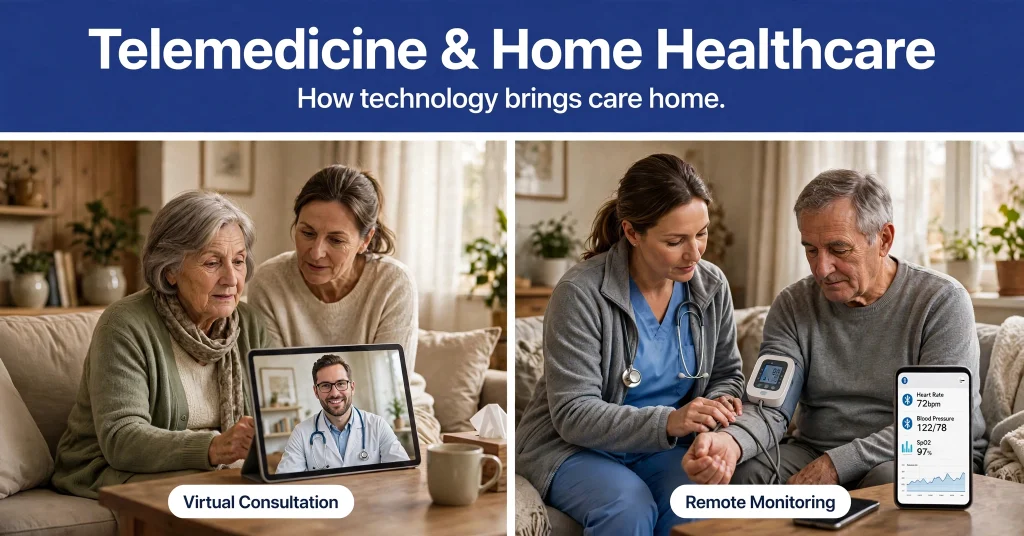
Telemedicine & Home Healthcare: How Technology Brings Care Home
A decade ago, “seeing a doctor” meant a commute, a waiting room, and often a half-day off work. Today, a growing share of that care happens over video calls, wearable sensors, and remote monitoring dashboards — without the patient ever leaving their bed. For families managing a loved one’s recovery or chronic condition at home, understanding how telemedicine actually works — and where it still falls short — makes a real difference in the quality of care you can arrange.
The Rise of Telehealth in Home Care
More Doctor Consultations via Video
Video consultations moved from a niche convenience to mainstream practice largely because of necessity during the pandemic years, and the shift has stuck. Regulatory clarity helped: the Government of India released formal telemedicine practice guidelines for Registered Medical Practitioners on March 25, 2020, during the COVID-19 outbreak, giving doctors a clear legal framework for offering remote consultations rather than operating in a gray area. That framework — the Telemedicine Practice Guidelines — is still the backbone of how virtual consultations are regulated in India today. Thsti
Government Support Through ABDM
Much of this is now backed by national digital health infrastructure. The Ayushman Bharat Digital Mission (ABDM) aims to build the backbone for an integrated digital health infrastructure across the country, bridging gaps between different stakeholders in the healthcare ecosystem through digital connectivity. In practice, that means a growing national registry of verified healthcare professionals and a unified personal health record system that lets patients store, view, and manage their medical history in one place — infrastructure that makes remote and home-based care far easier to coordinate safely than it was even five years ago. WikipediaDigital Health News
The government also runs its own free telemedicine platform, eSanjeevani, which operates in two modes — a provider-to-provider system connecting smaller health centres with specialists at hub hospitals, and a direct patient-to-doctor OPD service that lets people consult a doctor from home. The service has already served well over 100 million patients nationally through a network of thousands of hubs and spokes across states and union territories — a scale that reflects just how mainstream home-based virtual care has become in India.
Remote Patient Monitoring (RPM) Technologies
Wearables and Home Sensors Tracking Vitals
Beyond video calls, a growing category of connected devices lets patients’ vital signs flow directly to their care team without anyone leaving the house. Bluetooth-enabled blood pressure cuffs, pulse oximeters, and glucometers can log readings automatically, building a real trend line for doctors instead of a single snapshot taken once every few weeks in a clinic.
Central Monitoring Centers Alerting Doctors to Changes
For higher-risk patients, some home healthcare providers pair these devices with a monitoring team that watches for concerning trends — a blood pressure reading trending upward over several days, for instance — and flags it to the treating doctor before it becomes an emergency. This is the same principle behind hospital monitoring, just extended into the home.
Practical Applications
Virtual Check-Ins for Chronic Disease Management
Chronic conditions like diabetes and post-stroke recovery benefit enormously from frequent, low-friction check-ins rather than infrequent in-person visits. If you’re managing a loved one’s recovery after a stroke, our guide on stroke rehabilitation at home covers how virtual therapist check-ins fit into a broader rehab plan. The same applies to diabetes management at home, where routine virtual reviews of glucose logs can catch problems early.
Tele-Physio and Tele-Nutrition Sessions
Physiotherapy and dietary guidance don’t always require an in-person visit either. A physiotherapist can watch a patient perform exercises over video and correct form in real time — useful for the kind of post-operative physiotherapy exercises we’ve covered separately — and a dietitian can review a week’s meal photos or logs remotely just as effectively as in a clinic.
Benefits of Telehealth at Home
Immediate Access to Specialists Without Travel
For families outside major cities, or simply dealing with Delhi NCR traffic, virtual specialist access can cut what would be a half-day round trip down to a 20-minute call — critical when a patient is frail, in pain, or immunocompromised and travel itself carries risk.
Peace of Mind for Families
When vitals are logged and visible to family members as well as clinicians, there’s less guesswork. Adult children living elsewhere can see how a parent’s recovery is actually trending, rather than relying on a phone call description alone.
How Caroline Healthcare Uses Telehealth
Scheduled Virtual Follow-Ups After Major Events
After a hospital discharge — whether following surgery (see our comparison of home vs. hospital recovery) or a major health event — we schedule structured virtual follow-ups so a doctor reviews progress at set intervals, not just when something goes wrong.
Emergency Response Backed by Real-Time Access to Doctors
Our home nurses aren’t operating in isolation. When something changes unexpectedly, they can connect with supervising doctors in real time rather than waiting for the next scheduled visit — the same clinical backup you’d expect in a hospital ward, brought into the home. If you’re weighing how much clinical oversight your situation needs versus daily living support, our breakdown of home nurse vs. caretaker roles can help you figure out the right mix.
Frequently Asked Questions
Is an online doctor consultation as good as an in-person visit?
For routine follow-ups and straightforward evaluations, yes — virtual consultations can effectively support chronic condition monitoring. In-person visits remain necessary when a physical examination or hands-on procedure is required.
What equipment is needed for remote monitoring?
Usually just a smartphone or tablet, plus a small device or two — a Bluetooth blood pressure cuff or pulse oximeter, for example. We can arrange these so caregivers can log vitals directly for the treating doctor.
How secure are telemedicine sessions?
Platforms used for clinical teleconsultation are built around healthcare data privacy standards, with encrypted data transmission, in line with the government’s Telemedicine Practice Guidelines.
Does insurance or a government scheme cover telehealth?
Coverage varies. Government platforms like eSanjeevani offer free teleconsultations directly, separate from hospitalization-focused schemes like Ayushman Bharat PM-JAY. Some private insurers now cover teleconsultations under specific policies — it’s worth checking your plan directly, and our team can help you understand what’s available.
What if the internet connection at home is poor?
We also offer phone consultations as a backup. Our field nurses can additionally record patient data during in-person visits and transmit it once they reach better connectivity.
Curious how virtual check-ins could fit into your loved one’s care plan? Talk to Caroline Healthcare about setting up telehealth-supported home care.