Home Nurse vs Caretaker: Who to Hire? | Home Healthcare Explained
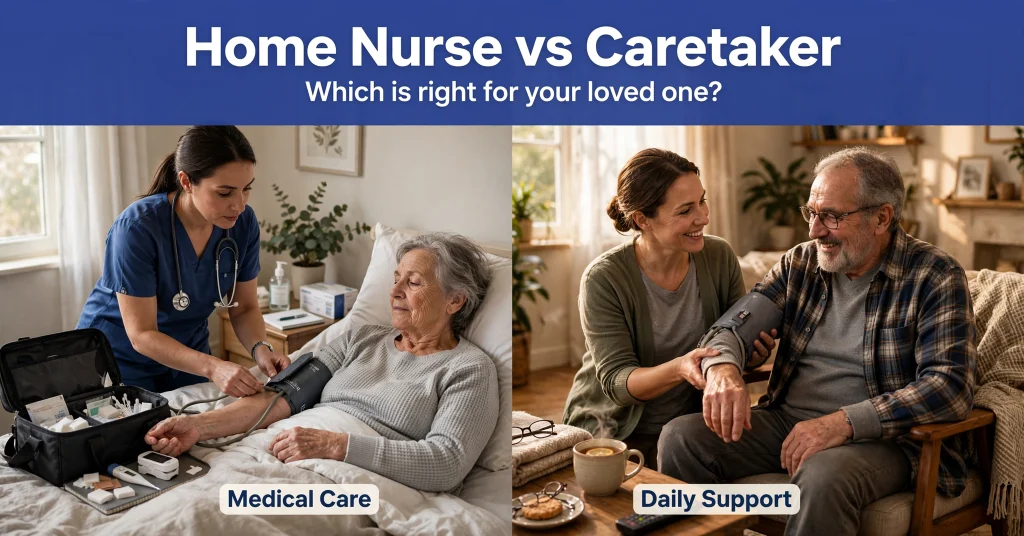
Home Nurse vs Caretaker: Which Is Right for Your Loved One?
When a family member needs help at home — after a surgery, during a chronic illness, or simply due to age — one of the first questions is: do we need a nurse, or a caretaker? The terms get used interchangeably, but they describe very different kinds of support. Getting this right matters, both for your loved one’s safety and for your budget.
Here’s how to tell the two apart, and how to decide which one your family actually needs.
What a Home Nurse Does (Certified Medical Care)
A home nurse is a licensed medical professional, trained to deliver clinical care outside a hospital setting.
Skilled Tasks: Injections, Wound Care, IV Fluids
Nurses handle the tasks that require medical training and legal authorization — administering injections, changing surgical wound dressings, managing IV fluids, and performing catheter or tube care. These are procedures where a mistake can have real medical consequences, which is exactly why they’re restricted to trained professionals.
Medication Management & Vital Sign Monitoring
Beyond hands-on procedures, a nurse tracks the bigger clinical picture — making sure medications are given at the right time and dose, monitoring blood pressure, oxygen levels, and temperature, and recognizing early warning signs that a doctor needs to be informed. This kind of oversight is what allows many patients to recover safely at home instead of in a hospital bed.
What a Caretaker/Attendant Does (Basic Assistance)
A caretaker — sometimes called an attendant — provides essential day-to-day support, but doesn’t perform medical procedures.
Non-Medical Support: Bathing, Feeding, Mobility Support
This covers the practical realities of daily life when someone can’t fully manage on their own — help bathing and dressing, preparing and assisting with meals, and supporting safe movement around the house, whether that’s getting to the bathroom or simply going for a short walk.
Companionship and Daily Living Aid
Just as important is the human side of care. A good attendant offers company, conversation, and a reassuring presence — something that matters enormously for patients who are largely homebound, especially elderly patients living alone or recovering from a long illness.
Overlap & Collaboration
When Both Roles Work Together
For many families, the real answer isn’t “nurse or caretaker” — it’s both. A common setup has a nurse visiting once or twice a day (or on a scheduled shift) to handle medical tasks, while an attendant covers the rest of the day for daily living support and companionship. The two roles complement each other rather than compete.
How to Decide: Patient Needs & Budget
Medical Complexity
If your loved one has an open wound, needs injections, is on IV medication, or has a condition that requires close monitoring, a nurse isn’t optional — it’s a safety requirement. High-acuity situations (post-surgery, serious chronic illness, unstable vitals) call for trained clinical care, full stop.
Social & Emotional Support
If the primary need is help with daily tasks and company — someone who’s otherwise medically stable but can’t safely manage alone — a caretaker may be entirely sufficient, and considerably more affordable than round-the-clock nursing.
Hiring Tips (Caroline’s Standards)
Checking Qualifications and Training
Whichever route you choose, verify credentials before anyone starts. For nurses, that means checking their nursing license and clinical background. For attendants, look for agencies that conduct structured training and background checks rather than informal hiring. At Caroline Healthcare, every nurse and attendant we place is vetted and trained before they ever meet a patient.
Trial Period and Feedback
A short trial period — even just the first few days — is one of the most useful tools families have. It lets you confirm the fit, both clinically and personally, before committing to a longer-term arrangement. We build in regular check-ins with families to catch and resolve any concerns early.
Frequently Asked Questions
Can a caretaker give injections or meds?
No — only a licensed nurse should administer injections or IV medications. A caretaker or attendant handles non-medical tasks only.
Which is more expensive, a nurse or an attendant?
Generally, nurses cost more due to their higher skill level and training. We offer both hourly and shift-based rates, and our team can help you find a cost-effective plan based on your loved one’s actual needs.
Can a caretaker also be a companion?
Yes — attendants often provide companionship, conversation, and help with daily routines, making them a great fit when the primary need is support with everyday activities rather than medical care.
How do I ensure quality?
We rigorously train and background-check all our staff, and regularly audit care plans with supervising clinicians to maintain consistent standards.
What if I need both?
Many families hire a nurse for medical care and an attendant for personal care. Caroline Healthcare can coordinate a combined schedule so both roles work together seamlessly.
Not sure which one your family needs? Talk to Caroline Healthcare — we’ll assess your loved one’s needs and put together the right combination of nursing and caregiving support.