ICU Care at Home – Guidelines for Families
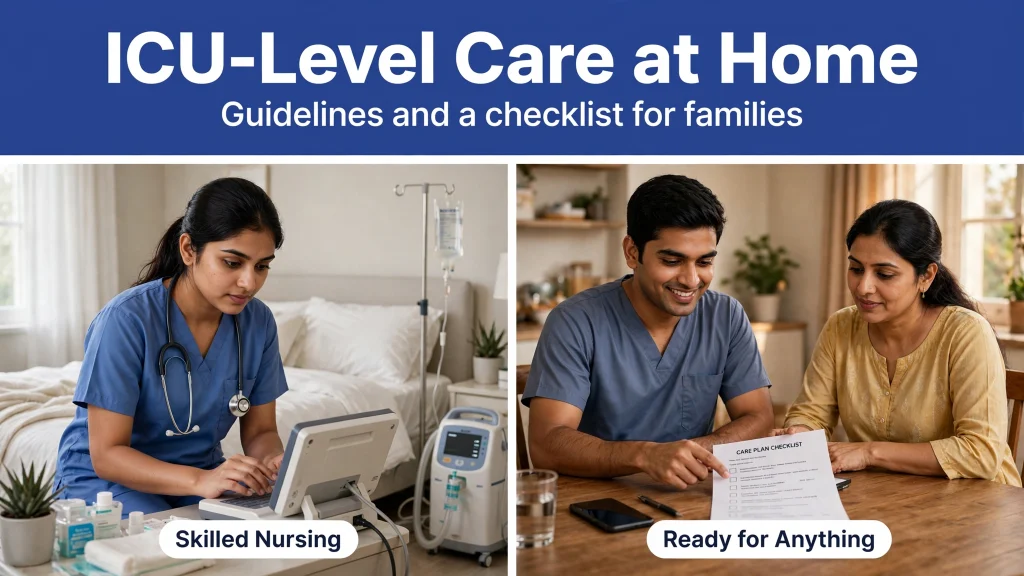
ICU-Level Care at Home: Guidelines and Checklist
Not every family facing a critical illness wants to hear this, but it’s worth saying plainly: home ICU care is not for every patient, and getting that judgment wrong is dangerous. This guide is written for families whose loved one’s doctor has already indicated they’re stable enough to be considered for home-based critical care — not as a substitute for that medical judgment.
Done right, with the right team and equipment, ICU-level care at home is a real and increasingly evidence-backed option. A large systematic review published in BMC Medicine examined “hospital at home” and virtual ward models — care that replicates inpatient-level monitoring outside a hospital — and found that these programs are being rapidly implemented internationally as technology-enabled alternatives to inpatient care. The evidence base is real, but so are the risks if it’s set up carelessly. Here’s what responsible home ICU care actually requires. nih
What Is “ICU at Home”?
High-Dependency Care: Ventilators, Monitors
Home ICU care means recreating hospital-level monitoring and life-support equipment in a home setting — continuous vital sign monitoring, oxygen or ventilator support, infusion pumps for medication, and a trained clinical team present around the clock. This is fundamentally different from standard home nursing (covered in our guide to home nurse vs. caretaker roles) — it’s a much higher tier of clinical intensity.
Who Qualifies
Good candidates are typically patients who’ve been stabilized in a hospital ICU — recently extubated (off a ventilator), no longer requiring emergency intervention, but still too medically fragile for unsupported recovery. Think severe COPD patients on oxygen, post-cardiac-surgery patients needing close monitoring, or long-term ventilator-dependent patients with tracheostomies. This is a decision made jointly by the treating hospital team and a home care provider — never a unilateral family choice.
Required Medical Equipment
Oxygen and Ventilator Setup
Depending on the patient’s needs, this can range from an oxygen concentrator to a full portable ventilator. Backup oxygen supply is non-negotiable — equipment failure during a power outage is exactly the kind of risk a proper home ICU setup plans around in advance, not after the fact.
Infusion Pumps, Cardiac Monitors, Suction Units
Continuous cardiac and oxygen saturation monitoring, IV infusion pumps for medication delivery, and a suction unit for patients who can’t clear their own airway are standard equipment for genuine ICU-level care. Caroline Healthcare’s Medical Equipment Rental service handles sourcing, delivery, and setup of all of this before the patient ever arrives home.
Staffing and Clinical Oversight
24/7 Nursing
This is the part families sometimes underestimate: “24/7 nursing” means a trained nurse physically present at all times, with shift rotations to ensure coverage through sleep breaks — not a nurse who visits periodically and leaves emergency contact numbers. For ICU-level patients, gaps in coverage are exactly when things go wrong.
Doctor Visits and an Immediate Response Plan
Regular physician oversight — whether through scheduled visits or structured telemedicine check-ins — needs to be paired with a clear, written escalation plan: who gets called first, what symptoms trigger an ambulance, and which hospital the patient returns to if things deteriorate. This plan should exist on paper before day one, not get improvised during a crisis.
Home Preparation & Safety
Clean Environment and Backup Power
Infection control matters as much at home as in a hospital ward — dedicated clean surfaces for equipment, consistent handwashing protocols, and appropriately disposed medical waste. A backup power supply (inverter or generator) for ventilators and monitors is essential; equipment that depends on continuous power cannot have gaps.
Family Training: Basic CPR and Warning Signs
Every family member involved in day-to-day care should know basic CPR and, critically, what specific changes in the patient’s condition mean “call the nurse now” versus “call an ambulance now.” The India-based Indian Society of Critical Care Medicine (ISCCM) — the country’s principal professional body for critical care medicine — runs structured CPR training programs, and any credible home ICU provider should be building this same training into the family’s onboarding, not assuming it’ll be figured out later.
Transitioning from Hospital to Home ICU
Coordination with the Hospital Team
A safe handover means the home care team receives a full clinical picture directly from the hospital — current medications, ventilator settings, recent lab work, and specific red flags to watch for — not just a discharge summary handed to the family to relay secondhand.
Insurance and Consents
Home ICU costs are typically significant, and it’s worth knowing upfront: most public schemes are built around hospitalization coverage, not sustained home-based critical care, so this is largely an out-of-pocket cost for most families. A good provider gives you a clear cost estimate before setup begins, not after.
Frequently Asked Questions
Who needs ICU-level home care?
Patients recently off ventilators or IV drips who remain too medically fragile for unsupported home recovery, or those needing constant monitoring — severe COPD with oxygen dependency, for example.
Is ICU care at home actually safe?
With the right setup — experienced critical care nurses, a clear emergency response plan, and properly maintained equipment — it can be both safe and more comfortable than an extended hospital stay, largely by reducing exposure to hospital-acquired infections. That safety depends entirely on the setup being done properly; it is not automatically safer than a hospital ICU.
What does “24/7 nursing” actually mean?
Around-the-clock shifts with a trained nurse physically present at all times, including rotation coverage so there’s never a gap during sleep breaks or shift changes.
Are oxygen concentrators and infusion pumps delivered and set up?
Yes — we arrange on-rent oxygen equipment and infusion pumps, and our team handles setup and trains the family on safe usage before the patient arrives home.
Can this be covered by insurance?
Public schemes like Ayushman Bharat PM-JAY are generally structured around hospitalization rather than sustained home-based critical care, so home ICU is typically an out-of-pocket cost — though usually still lower than an extended hospital ICU stay. We provide upfront cost estimates so there are no surprises.
Considering home ICU care for a loved one? Talk to Caroline Healthcare — our care coordinators will assess whether home-based critical care is medically appropriate and build the staffing and equipment plan around it.