Can an Eye Exam Reveal Heart Disease Risk? What Studies Say
October 12, 2026 · Caroline Healthcare
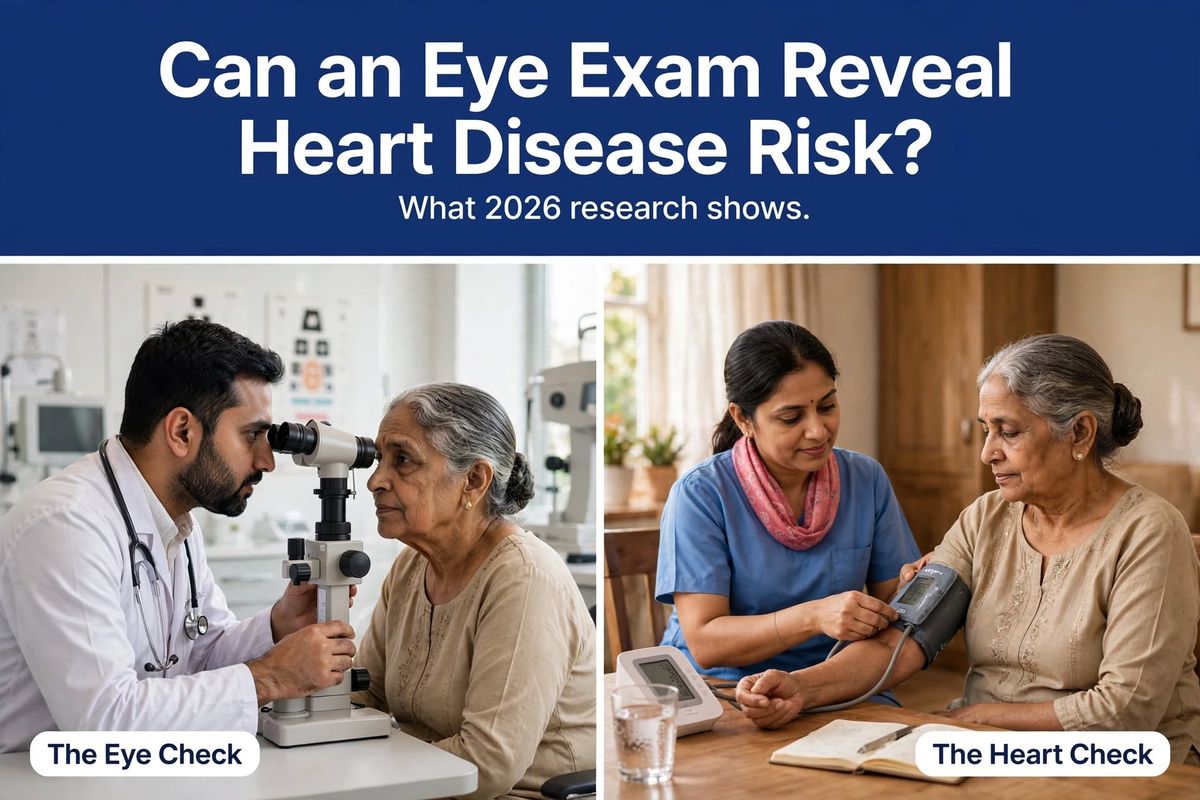
New 2026 research links changes in the retina to heart disease, stroke and diabetes. Learn what your eyes can reveal and who should get checked.
Can an Eye Exam Reveal Your Heart Disease Risk? What 2026 Research Shows
The retina, the thin layer at the back of the eye, is one of the only places where doctors can look directly at living blood vessels without any surgery or scan. That is why researchers keep asking whether those tiny vessels can warn us about problems elsewhere in the body, especially the heart. This year, several studies have pushed that idea forward, and the findings are interesting, as long as they’re read with the right caution.
Why the Eye Is a Window Into the Heart
The vessels in the retina are tiny, but they respond to the same forces that damage the larger arteries around the heart: stiffening, narrowing and inflammation. Eye doctors can already spot signs of high blood pressure, high cholesterol, diabetes and early heart disease during a routine exam, as Medical News Today summarises. What’s new is how much more detail researchers are now getting from retinal images, often with the help of AI.
What the New Studies Found
- Simpler vessel patterns, higher risk. A study in Science Advances found that people whose retinal blood vessels branch less (a “simpler” network) showed more inflammation and a higher risk of heart disease and stroke, as well as shorter lifespans.
- A “retinal age” that runs ahead. Researchers trained an AI model on more than 50,000 photographs of the back of the eye to estimate how old a person’s retina looks. Reported in April 2026, people with diabetes, heart disease or a past stroke tended to have a bigger gap between their retinal age and their actual age.
- It works in the other direction too. A UCLA Health study of 35,909 adults aged 40 to 79 found that a standard heart-risk score, the kind already used in primary care, can predict later eye disease. People in the highest-risk group were about nine times more likely to develop diabetic retinopathy than those in the lowest-risk group.
- AI screening at the eye clinic. At the American College of Cardiology’s 2026 meeting, researchers presented a system that estimates heart risk from eye images and agreed closely with standard risk assessments. About 1 in 4 participants turned out to have elevated risk. Worth knowing: that study was funded by the company that makes the tool.
The Honest Caveats
- These are mostly associations. They show that retinal changes and heart disease tend to appear together, not that one causes the other.
- The AI tools are early-stage. They are not a replacement for checking blood pressure, cholesterol and blood sugar, and they aren’t yet a standard part of eye check-ups. Ask your doctor what is actually available near you.
- A normal retina doesn’t rule out heart disease, and an unusual finding doesn’t mean you have it. Think of it as one more clue, not a diagnosis.
Why This Matters in India
India has an estimated 77 million people with diabetes, and diabetes is the biggest everyday link between the eyes and the heart. A national screening study in The Lancet Global Health found diabetic retinopathy in about 12.5% of people with diabetes aged 40 and over, roughly 1 in 8. Vision-threatening disease affected about 4%, which the authors estimate means at least 3 million Indians are at risk of or already living with vision loss from it.
Heart disease is also arriving earlier here, as we covered in our guide to heart attack warning signs. Together, those two facts make a regular eye exam more worthwhile for Indian families than the global advice might suggest.
Who Should Get a Comprehensive Eye Exam, and How Often
Ask your eye doctor for the right schedule, but as a general guide:
- People with diabetes: usually a dilated eye exam at least once a year. Our guide to diabetes care at home covers how to build this into the routine.
- Anyone with high blood pressure, high cholesterol or a family history of heart disease or stroke.
- Seniors: typically every 1 to 2 years, even without symptoms.
When an Eye Symptom Is an Emergency
Sudden loss of vision, sudden blurring, or sudden trouble seeing in one or both eyes can be a warning sign of a stroke. Don’t wait to see if it passes. Sudden vision problems are part of the BE-FAST warning signs covered in our guide to stroke rehabilitation at home, and they should be treated as a medical emergency.
What This Means for Caring for Parents at Home
- Put the eye exam on the yearly calendar for any parent with diabetes or high blood pressure, next to the blood tests and heart check-ups.
- Keep a log of blood pressure and blood sugar readings and bring it to the eye appointment. It helps the doctor read what they see in the retina.
- Treat vision changes as a fall risk. Poor eyesight is one of the quietly fixable causes covered in our guide to preventing senior falls.
Frequently Asked Questions
Can an eye exam detect heart disease?
Not directly, but an eye doctor can spot signs linked to high blood pressure, high cholesterol, diabetes and early heart disease. AI tools that estimate heart risk from retinal images are promising but still emerging.
Can eye changes warn of a stroke?
Yes. Sudden loss of vision or other sudden vision problems should be treated as an emergency and checked immediately.
Do I need to have diabetes to worry about this?
No. Diabetes raises the risk, but high blood pressure, high cholesterol, smoking and a family history all matter too. A comprehensive eye exam is useful for most adults, especially after 40.
How often should seniors get their eyes checked?
Typically every 1 to 2 years, and at least yearly if they have diabetes, unless their eye doctor advises otherwise.
Is AI retinal screening for heart disease available in India?
It’s mostly at the research stage. Ask your doctor or eye specialist what’s currently offered, and don’t use it in place of standard heart checks.